
Matteco, a Universitat de València spin-off, is the only Spanish company selected in the latest EIC Accelerator round
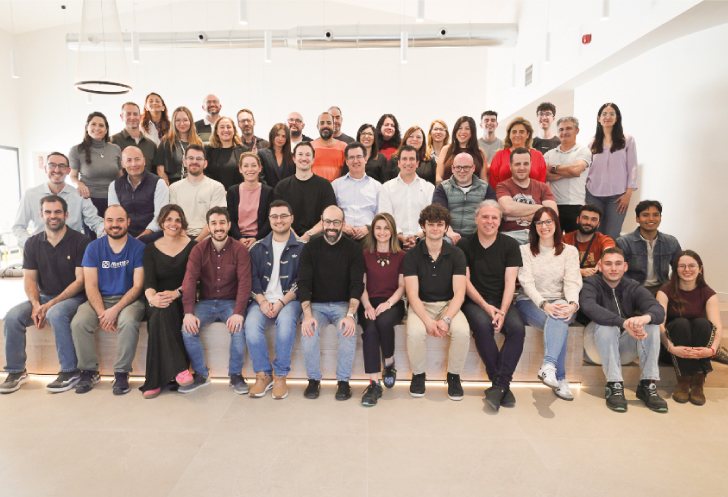
The company, which emerged from research at the Institute of Molecular Science (ICMol) at the Universitat de València Science Park, has successfully completed three evaluation stages and two interviews. Its ANOVA project is among the 35 initiatives selected from 453 full applications, opening the door for the European Union to become a shareholder in the company.
Paterna, 17 November 2026. Matteco, a Universitat de València spin-off originating from the Institute of Molecular Science (ICMol), is the only Spanish company selected in the latest EIC Accelerator round, a European Innovation Council (EIC) programme designed to support companies developing disruptive technologies with international growth potential.
The selection, announced on 16 November, includes 35 companies from 17 countries, out of 453 that submitted full proposals and 88 that reached the final interview stage. Among them is Matteco with ANOVA (ANodes for Optimised Value-chain Acceleration), a project focused on anodes, essential components of electrolysers used to produce green hydrogen. The principal investigator of the proposal is Gonzalo Abellán Sáez, co-founder and Chief Technology Officer (CTO) of Matteco, researcher at ICMol and Associate Professor of Inorganic Chemistry at the Universitat de València.
The European Union as a potential strategic shareholder in Matteco
The European Innovation Council has recommended blended finance for Matteco, combining grants with equity investment in the company through the EIC Fund. This means that European support could extend beyond funding an R&D project, opening the possibility for the European Union to become a shareholder in the company.
“The possibility of having the European Commission as a shareholder in Matteco represents an enormously significant strategic endorsement for the company, both in terms of the confidence placed in our technology and the opportunities it creates for our industrial growth and international expansion,” says Abellán.
The 35 selected companies will have access to a combined grant budget of €84 million, while 32 will be assessed for equity investments of up to €10 million per company. The individual amount corresponding to Matteco has not been disclosed, and any investment remains subject to assessment and formalisation.
Three evaluation stages and two interviews
This achievement is particularly significant given the demanding selection process: only 7.7% of full applications were selected. Companies must pass an initial evaluation, submit a full proposal outlining their technological and business strategies, and complete a first interview with an expert. Those advancing to the final stage defend their applications before an EIC jury, in Brussels in Matteco's case. The assessment considers technological excellence, commercial viability and scalability.
Advanced materials to reduce the cost of green hydrogen
Green hydrogen is produced through electrolysis, a process that uses electricity from renewable sources to split water into hydrogen and oxygen. Some electrolysis technologies require precious metals such as iridium or platinum, whose scarcity and cost can limit industrial expansion.
Matteco develops catalysts and electrodes free of platinum-group precious metals for alkaline and anion exchange membrane (AEM) electrolysers. Its technology aims to combine more abundant materials with high catalytic activity, durability and energy efficiency. ANOVA focuses on anodes and the optimisation of their value chain.
From ICMol research to industrial manufacturing
Founded in 2023, Matteco has its origins in more than a decade of advanced materials research carried out by Gonzalo Abellán and his team in the 2D-Chem group at ICMol, a research institute within the scientific and academic area of the Universitat de València Science Park. Collaboration with Iker Marcaide, founder of Zubi Group and CEO and co-founder of Matteco, enabled this scientific knowledge to be transferred to the industrial sector.
“It is particularly meaningful to see how knowledge generated over more than a decade in a university laboratory can become an industrial technology capable of competing internationally,” says Abellán.
In 2024, Matteco closed a €15 million funding round to expand its production capacity and develop its factory in Paterna. The company currently employs around 50 professionals and has made its first sales in China.
The spin-off maintains its scientific collaboration with the Universitat de València through projects such as SEAL-HYDROGEN, which also involves Siemens Energy, the Helmholtz Institute Erlangen-Nürnberg and Horiba. The consortium has identified five catalyst compositions free of critical raw materials, produced at kilogram scale and evaluated under real electrolysis conditions. This is a separate project from ANOVA.
Matteco's selection and the prospect of the European Union becoming an investor represent a new milestone in knowledge transfer from the Universitat de València and its contribution to industrial development in strategic sectors for the energy transition.
Fuente: Comunicación del Parc Científic de la Universitat de València.